Kategorij: Raksti
Vecuma grupa: 19 – 25
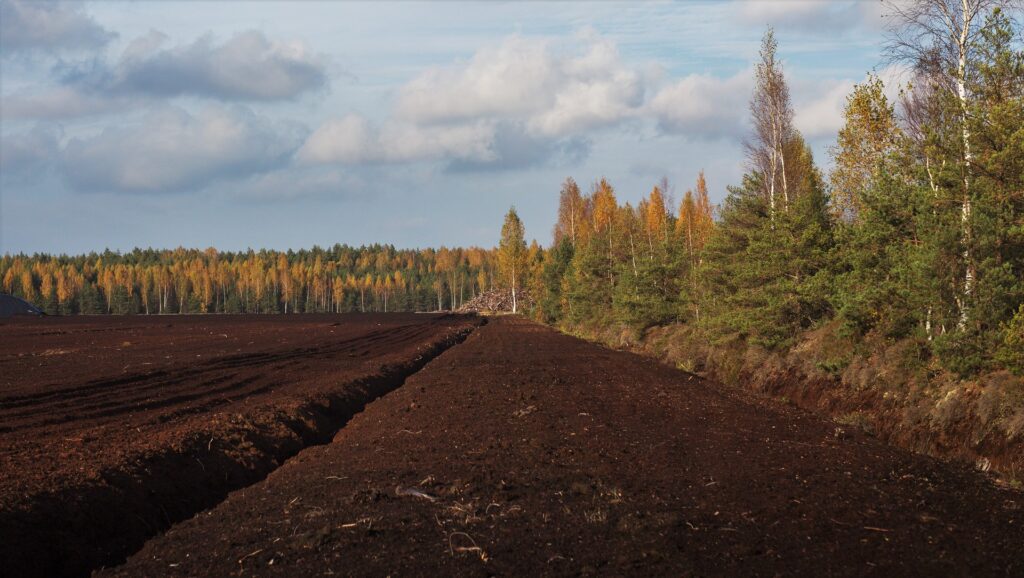
Not many people realize that in Latvia, some drained peatlands can release more greenhouse gases than factories or highways. What was once an old land-use practice has become a modern climate problem, with consequences for food production, rural jobs, and Europe’s wider environmental choices.
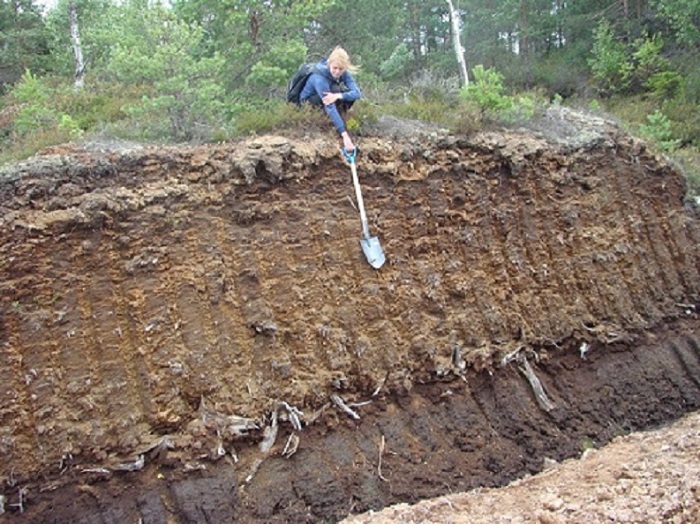
To understand why this matters, peatlands are wetlands where dead plants do not fully decompose. Over long periods, they form peat, a carbon-rich soil that stores greenhouse gases underground. When peatlands remain wet, they act as natural carbon storage. But when they are drained for farming and peat extraction, oxygen enters the soil, decomposition speeds up, and stored carbon begins to escape into the atmosphere. In this sense, peatlands themselves are not the problem, however, draining them turns them from carbon stores into emission sources.
Latvia’s case is bigger than it appears
Peatlands cover about 10 percent of Latvian territory, or roughly 640,000 to 645,000 hectares, and according to the LIFE Peat Restore project, around 63 percent of these peatlands are in a drained state. A 2022 study by Latvian researchers published in the proceedings “Rural Development 2022” gives a broader picture, showing that organic soils, which include both natural peatlands and drained peat soils, cover about 19 percent of Latvia’s area, with around 629,000 hectares already drained. Together, these figures show that the issue extends far beyond untouched peatlands and has become one of Latvia’s central land-use and climate challenges.
The roots of this situation are historical. European Commission material on Latvian peatland restoration shows that drainage expanded during the Soviet period and continued up to the 1990s. In other words, today’s emissions are not only the result of current decisions, but also the result of an older system that reshaped land for agriculture, forestry, and extraction without fully considering long-term climate costs.
The emissions numbers are serious. LIFE Peat Restore estimates that drained bogs, fens, and transition mires in Latvia release around 3.6 million tonnes of CO2 per year. When other drained land uses such as forest land, grassland, arable land, and peat extraction areas are included, the total rises to about 13.5 million tonnes annually. Latvia’s official 2025 climate projections report goes further and warns that persistent emissions from organic soils are one of the main reasons the country is struggling with its land-use climate targets by 2030.
Why the issue is so difficult
Peat also matters economically in Latvia. Latvian public media and industry representatives have repeatedly noted that Latvia supplies about 31 percent of the peat used in professional horticulture in Europe. According to a report cited by LSM and Research Latvia, the sector supports thousands of jobs, especially in rural areas. Industry representatives also argue that peat remains important for commercial plant and vegetable production.
On one side is a land-use system linked to jobs, exports, and food production. On the other side is a climate burden that keeps growing. This tension becomes even clearer in old extraction areas. As project manager Maija Rieksta noted in Latvian public media, some of the most problematic sites are those where extraction ended but no proper recultivation followed. Latvian restoration work has identified more than 50,000 hectares of peat-extraction-affected land, including around 18,000 hectares considered degraded.
Drained peatlands also damage biodiversity, disturb water systems, and increase long-term land degradation. Latvian researchers note that drainage alters water systems, affecting water quality and weakening the natural storage function of peatlands.
What other countries show
Latvia is not alone, and that is what makes this a global issue rather than just a local one. Trade data from the World Integrated Trade Solution shows that peat moves through a large international market. In 2024, major importers included the United States, the Netherlands, China, Germany, and France. Major exporters included Canada, Latvia and Estonia. A peer-reviewed Europe-wide material flow study found that around 20 million tonnes of peat were extracted yearly in Europe in 2013–2017, with northern producers supplying western and central European horticultural markets.
Different countries are now trying different solutions. Finland offers one of the most useful examples for Latvia because it treats drained peatlands as both a climate and land-use issue. Finnish policy work has developed a roadmap for peatland fields, while a 2024 study found that rewetting and paludiculture could reduce emissions significantly, though farmer compensation would be necessary. Germany shows the demand side of the story. Its official peat reduction strategy aims to cut peat use in commercial horticulture and phase it out in hobby gardening. The Netherlands matters as a major importer and market hub, showing that countries that do not extract as much can still shape demand.
What Latvia can do next
The strongest solution would be a planned transition, rather than an immediate ban. Rewetting the worst-emitting sites is the clearest climate step, because wetter peat releases less carbon. But it must be backed by funding and realistic alternatives for landowners. Latvia’s own restoration guidance shows that after-use should depend on each site. Some areas can be rewetted. Others can support berry cultivation, forests, water bodies, or paludiculture, which means producing biomass or crops on wet peatlands instead of drained ones.
At the same time, Europe must reduce demand for peat in horticulture. Germany’s strategy and research on alternatives such as wood fibre, bark, compost, and coir show that lower-impact substitutes already exist, even if they are not yet perfect or universal. EU policy is also moving in this direction. The Nature Restoration Regulation, in force since 2024, includes targets for drained peatlands under agricultural use, pushing Member States to plan more seriously.
Latvia can no longer treat drained peatlands as a silent background issue. What looks like empty wet land is in fact part of Europe’s climate system, food system, and political future. Latvia has the data, the restoration tools, and the EU framework. What it lacks is urgency, and time is the one thing peatlands cannot store.
References:
- European Commission (2023) JTP Groundwork delivered technical assistance in Latvia. https://ec.europa.eu/regional_policy/whats-new/newsroom/14-12-2023-jtp-groundwork-delivered-technical-assistance-in-latvia_en
- LIFE Peat Restore (n.d.) Peatlands in Latvia: emissions and restoration data. https://life-peat-restore.eu/en/project/latvia/
- Kaleja, S. and Bardule, A. (2022) ‘Review of climate change mitigation measures applicable in degraded peatlands in Latvia’, Research for Rural Development 2022, 37, pp. 56–62. DOI: 10.22616/rrd.28.2022.008
- Latvian State Forest Research Institute “Silava” (2023) Organic soils and GHG emissions in Latvia (ERAF project summary) https://www.silava.lv/images/Petijumi/2022-ERAF-031/2023-07-31-ERAF-031-Press-release-Summary.pdf
- Latvijas Vides, ģeoloģijas un meteoroloģijas centrs (2025) Latvia GHG projections and policies report.
https://videscentrs.lvgmc.lv/files/Klimats/SEG_emisiju_un_ETS_monitorings/Zinojums_par_klimatu/SEG_prognozu_pilnie_zinojumi/2025/LV_Report%20_Projections%20and%20PaMs_2025.pdf - LIFE REstore Project (2019) Sustainable and responsible management of degraded peatlands in Latvia (final report).
https://restore.daba.gov.lv/public/download.php?id=338 - Latvian Peat Association (n.d.) GHG emissions and peatland management data.
https://www.latvijaskudra.lv/en/Interesting_information/ghg_emissions/ - PeatCarbon Project, University of Latvia (n.d.) Peatland climate mitigation overview.
https://www.peatcarbon.lu.lv/en/project-summary/project-summary/ - Research Latvia / LBTU (2025) Peat industry transition and climate impact. https://www.researchlatvia.gov.lv/en/latvia-university-life-sciences-and-technologies-researchers-develop-sustainable-solutions
Autors: Adkhamjon Janobiddinov (20)